

Research Classes

Selank Peptide Research: Tuftsin Analog, GABA and BDNF Studies
Selank peptide research starts with an unusual origin story. Most research peptides begin as fragments of a hormone or growth
Looking for research-grade compounds?
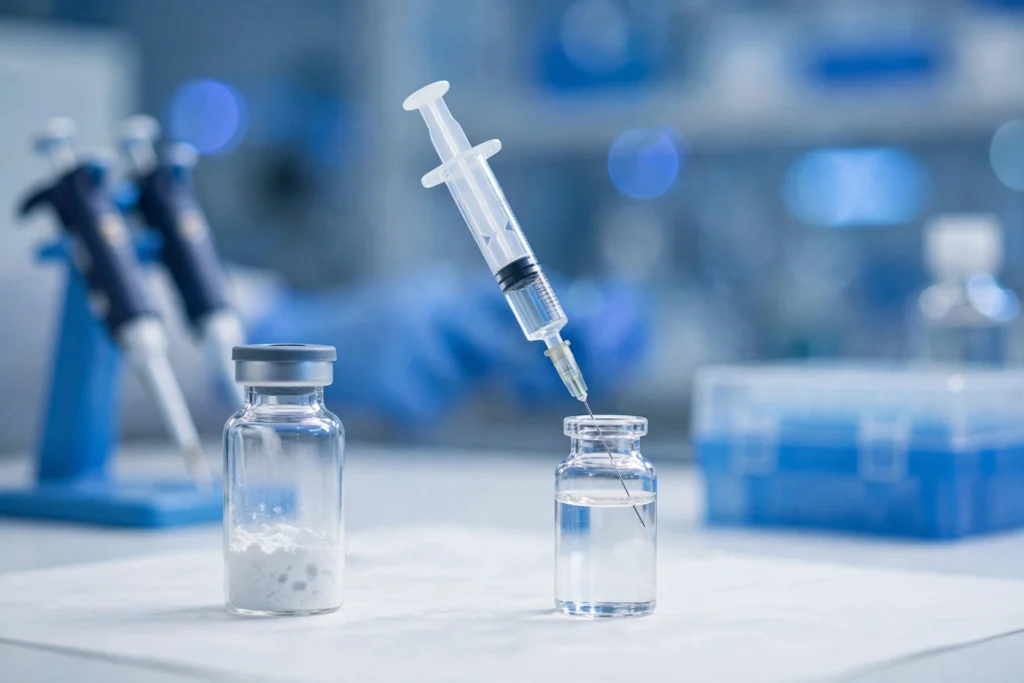
Reconstitution is the first hands-on step between a lyophilized peptide vial and a usable research solution — and it’s where a surprising share of lab errors originate. Learning how to reconstitute peptides correctly protects the compound’s integrity, keeps results reproducible across batches, and ensures the material behaves the way its Certificate of Analysis says it should. A degraded or contaminated stock solution quietly corrupts every experiment downstream of it, and the data never tells you it happened.
This guide covers the full workflow: why peptides ship as dry powder, solvent selection, the step-by-step lab protocol, concentration math for working solutions, post-reconstitution storage, and the mistakes labs make most often.
Research peptides are almost universally supplied lyophilized (freeze-dried) — a white, fluffy powder or thin cake at the bottom of the vial. That’s deliberate chemistry, not cheap packaging.
In solution, peptides are vulnerable to several degradation pathways that barely operate in the dry state:
Lyophilization removes nearly all water, freezing these reactions. A properly lyophilized peptide stored at −20°C typically remains stable for years. The moment solvent hits the powder, the clock starts — which is why reconstitution technique and post-reconstitution storage matter so much.
Never reconstitute material you haven’t qualified — no technique rescues a bad batch. Before mixing anything:
If the material has no third-party COA at all, that’s the red flag, not a detail. Apex’s third-party COA testing program exists precisely because identity and purity verification is the foundation everything else rests on.
Solvent choice is the highest-leverage decision when learning how to reconstitute peptides — it permanently sets the solution’s properties. The right choice depends on the peptide’s solubility and how long the solution needs to last.
Bacteriostatic water (BAC water) is sterile water containing 0.9% benzyl alcohol as a preservative. It is the standard reconstitution solvent for most research peptides: the benzyl alcohol inhibits bacterial growth after the vial is punctured, extending the usable life of the reconstituted solution to roughly 21–28 days refrigerated at 2–8°C. For multi-week research workflows with serial aliquot withdrawals, BAC water is the correct choice. Always check the peptide’s documentation first; a small number of peptides are documented as incompatible with benzyl alcohol.
Sterile water for injection contains no preservative. It offers zero antimicrobial protection after the first needle puncture, so solutions prepared in sterile water should be treated as single-use: prepare, use within 24 hours, and discard. It is the right choice when the experimental protocol demands preservative-free material or when the compound is incompatible with benzyl alcohol.
Some peptides are pH-sensitive or aggregate at neutral pH in plain water. For these, phosphate-buffered saline (PBS) or a mild acetate buffer may be specified to hold the solution in a stable pH range. This is a per-compound decision — follow the vendor’s or literature’s documented buffer, concentration, and pH, rather than improvising.
Some peptides — particularly longer or hydrophobic sequences — won’t dissolve in water alone. The standard approach: dissolve the peptide first in a small volume of an organic co-solvent (commonly DMSO or dilute acetic acid), then dilute with sterile buffer or water to the final working concentration. Keep the co-solvent fraction as low as the protocol allows, since high DMSO percentages can interfere with downstream assays, and verify that the final solvent system is compatible with your analytical method.
| Solvent | Preservative | Typical Usable Life (2–8°C) | Best For |
|---|---|---|---|
| Bacteriostatic water | 0.9% benzyl alcohol | 21–28 days | Multi-week research workflows (default) |
| Sterile water | None | ~24 hours | Preservative-free or single-use protocols |
| PBS / acetate buffer | None (typically) | Per compound | pH-sensitive peptides per documentation |
| DMSO then dilute | Varies | Per protocol | Hydrophobic peptides that resist aqueous solvents |
This is the procedure for preparing a peptide stock solution under clean lab conditions:
Reconstitution math is simple arithmetic, but it deserves a double-check every time, because a wrong volume silently scales every downstream result. The relationship: Concentration (mg/mL) = peptide mass (mg) ÷ solvent volume (mL).
Worked example: a 10 mg vial reconstituted with 2 mL of solvent gives 10 ÷ 2 = 5 mg/mL — or 5,000 mcg/mL. To prepare a working aliquot of a target amount, divide the target by the concentration: 500 mcg ÷ 5,000 mcg/mL = 0.1 mL.
Two practical guidelines labs use when choosing the solvent volume:
Pick the volume that lands your typical withdrawal in a comfortably measurable range, and verify the calculation before committing solvent to the vial. Our peptide storage best practices covers how concentration and storage format interact for long-term stability.
The moment a peptide is in solution, degradation pathways reactivate. Storage rules change completely:
A compromised solution often announces itself. Discard the vial if you observe:
| Mistake | What Goes Wrong |
|---|---|
| Shaking the vial | Mechanical shear denatures peptide chains; potency loss |
| Spraying solvent directly onto powder | High-pressure stream damages fragile peptides |
| Using non-sterile or wrong diluent | Bacterial contamination; wrong pH degrades the compound |
| Skipping the alcohol swab | Introduces bacteria through the needle puncture |
| Storing reconstituted vials at room temperature | Degradation accelerates; potency can drop within days |
| Reusing syringes between vials | Cross-contamination; dulled needles damage stoppers |
| Not labeling the vial | No way to verify age or concentration — the solution is unusable |
Research-grade work demands research-grade records. Every reconstitution should be logged with the peptide name, supplier batch number, solvent type and volume, final concentration, date, and the preparer’s initials. Electronic lab notebooks or batch tracking sheets work equally well — the format matters less than the consistency. When a result looks anomalous weeks later, this log is what lets you trace it to the preparation rather than the hypothesis. Getting the details right is what knowing how to reconstitute peptides is really about: the technique is simple, but the discipline is what protects the data.
Q: How long does a reconstituted peptide last?
A: With bacteriostatic water, refrigerated at 2–8°C, most reconstituted peptides remain usable for roughly 21–28 days. With preservative-free sterile water, treat the solution as single-use and discard within 24 hours. Compound-specific stability varies — always defer to documented data for the specific peptide.
Q: Can I freeze a peptide after reconstituting it?
A: No. Freeze-thaw cycling damages dissolved peptides through ice-crystal shear, causing aggregation and potency loss. Freeze only lyophilized (unreconstituted) vials, which remain stable for years at −20°C.
Q: What happens if I shake the vial?
A: Shaking creates air-liquid interfaces and mechanical shear that can denature peptide chains, reducing the effective concentration of intact peptide. Gentle swirling or rolling is sufficient for nearly all research peptides.
Q: My peptide won’t dissolve. What now?
A: Let it sit at room temperature and swirl gently — impatience destroys more vials than chemistry does. If it still resists, it may be hydrophobic: dissolve in a small volume of DMSO or dilute acetic acid first, then dilute with buffer. Check the product documentation for compound-specific solubility guidance.
Pair your reconstitution protocol with sterile vials, syringes, and other research supplies.
Related in the Apex shop: BAC Water — supplied strictly for laboratory research use.
All peptides discussed are strictly for laboratory research use only — not for human or veterinary use, and not for diagnostic or therapeutic purposes. Nothing in this guide is dosing advice or a usage instruction for any living organism; it describes laboratory handling technique for preparing analytical and in-vitro research solutions. Researchers are responsible for following their institution’s protocols and all applicable regulations.
Selank peptide research starts with an unusual origin story. Most research peptides begin as fragments of a hormone or growth
Retatrutide Peptide Research: The Triple Agonist, TRIUMPH Trials and FDA Status Retatrutide peptide research is where incretin science stopped adding

Sermorelin Peptide Research: GHRH(1-29), GH Pulses and FDA History Sermorelin peptide research occupies an unusual place in the peptide literature:
Join the Apex list for research articles, compound guides, and subscriber-only offers. Enter your email and your 10% code appears instantly.
Use code Apex10
at checkout for 10% off.

Age Requirement
You must be 21 years or older to enter this website.
Apex Bio Industries is intended only for adults aged 21 and older. Individuals under the age of 21 are not permitted to access, purchase, or interact with products or content available through this website.
Research Use Only
All products offered by Apex Bio Industries are intended strictly for Research Use Only (RUO) purposes. These products are provided exclusively for laboratory research, scientific investigation, and educational purposes by qualified researchers and institutions. Products are not intended for human consumption, clinical use, medical treatment, diagnosis, prevention, or cure of any disease or condition. Apex Bio Industries does not provide medical advice, treatment recommendations, or instructions for personal use. Customers are responsible for ensuring that their purchase, handling, storage, and use of products comply with applicable laws, regulations, and institutional guidelines.
Please check the box above to confirm you are 21 years or older.