

Research Classes

Selank Peptide Research: Tuftsin Analog, GABA and BDNF Studies
Selank peptide research starts with an unusual origin story. Most research peptides begin as fragments of a hormone or growth
Looking for research-grade compounds?
GHK-Cu peptide research is one of the longest-running stories in peptide science — and one of the most misunderstood. The copper tripeptide turns up in glossy serums, in wound-healing studies, and increasingly in longevity discussions that outpace the evidence. Strip away the marketing, though, and you’re left with a genuinely interesting molecule: a small, naturally occurring copper complex first isolated from human plasma in 1973 that has since been studied across dermatology, wound repair, gene-expression profiling, and nerve regeneration models. This article reviews what GHK-Cu peptide research actually shows — the mechanisms, the human data, and the boundaries of what remains unverified — strictly through a laboratory research lens.
GHK-Cu is the copper(II) complex of glycyl-L-histidyl-L-lysine (GHK), a tripeptide — three amino acids — with a strong affinity for copper ions. The GHK sequence occurs naturally in the human body; it is found in blood plasma, saliva, and urine, and it appears to be released from larger proteins at sites of tissue injury, where it binds available copper and forms the active GHK-Cu complex. In the literature, you’ll see it called copper tripeptide-1, copper peptide, or prezatide copper; all refer to the same GHK–Cu²⁺ entity.
The molecule’s discovery traces to chemist Loren Pickart in the early 1970s, who isolated GHK from human plasma while investigating why plasma from younger adults seemed to rejuvenate aged liver cells in culture. He subsequently documented that circulating GHK levels decline markedly with age — research commonly cites a drop from roughly 200 ng/mL in young adults to around 80 ng/mL by age 60, an approximate 60% decrease that runs parallel to the slower wound healing and reduced tissue repair capacity observed in aging. The Cu-bound form has a molecular weight near 403 g/mol and is characteristically blue in solution, a visible marker of the copper complex that laboratories recognize immediately.
The bare GHK tripeptide and its copper complex are not interchangeable in the research literature. GHK alone binds copper with high affinity, but the biological activity documented in most studies — fibroblast stimulation, antioxidant effects, gene modulation — is attributed to the copper-carrying complex. GHK-Cu effectively acts as a copper chaperone: it transports Cu²⁺ to copper-dependent enzymes such as lysyl oxidase (which cross-links collagen and elastin) and superoxide dismutase (a core antioxidant enzyme). This dual role — signaling molecule and mineral courier — is central to understanding why GHK-Cu appears in so many different research contexts.
| Property | GHK (free tripeptide) | GHK-Cu (copper complex) |
|---|---|---|
| Composition | Gly-His-Lys only | Gly-His-Lys + Cu²⁺ |
| Copper binding | High affinity, readily chelates | Already copper-saturated |
| Color in solution | Colorless | Distinct blue |
| Documented activity | Precursor/carrier role | Full activity in published studies |
| Occurrence | Released at wound sites, binds local copper | Formed in vivo where copper is available |
GHK-Cu peptide research attributes the compound’s broad footprint to several overlapping mechanisms rather than a single receptor pathway. The sections below follow what has been documented in cell culture, animal models, and human studies — with the evidence tier noted for each.
The best-documented mechanism involves dermal fibroblasts, the cells responsible for producing the skin’s structural framework. Laboratory studies have associated GHK-Cu with increased synthesis of collagen types I and III, elastin, and glycosaminoglycans such as decorin and dermatan sulfate. Decorin is particularly interesting to researchers because it regulates collagen fibril formation — it doesn’t just help produce collagen, it helps organize it into functional architecture.
Equally important is the other side of the ledger: matrix metalloproteinases (MMPs), the enzymes that break down collagen and elastin. GHK-Cu has been associated with modulation of MMP activity while raising levels of TIMPs (tissue inhibitors of metalloproteinases), the natural brakes on those enzymes. In research terms, the compound appears to act on both collagen production and collagen preservation — a two-sided effect on extracellular matrix homeostasis.
Beyond the structural work, GHK-Cu peptide research has documented suppression of pro-inflammatory signals including TNF-α and IL-6 and modulation of the NF-κB signaling pathway in experimental models. On the antioxidant side, studies associate the complex with increased activity of superoxide dismutase and with activation of the Nrf2 pathway — the cell’s master switch for antioxidant enzyme production. Researchers studying aging tissue take interest here because chronic low-grade inflammation and oxidative stress are two of the most consistently documented drivers of age-related tissue decline.
Perhaps the most striking finding in GHK-Cu peptide research comes from gene-expression profiling. Bioinformatic analyses of human gene-expression databases have reported that GHK-Cu influences the activity of more than 4,000 human genes in vitro — roughly a third of the genome at sufficient concentrations — with repair-related genes upregulated and inflammation- and aging-associated genes downregulated. For a tripeptide, that breadth is unusual, and it explains why the compound appears across so many therapeutic research areas.
Researchers should treat these findings with the appropriate caution: they are in vitro observations, not proof of systemic effects in living organisms. But as a hypothesis generator for laboratory work, the gene-expression footprint is genuinely remarkable — it positions GHK-Cu as a regulatory-type peptide rather than a single-target agent. Anyone sourcing GHK-Cu for this kind of work should confirm identity and purity carefully — copper complexes can be mislabeled, and mass spectrometry on the COA is the standard identity check (our guide to reading a COA walks through what to look for).
In wound models, GHK-Cu has been associated with accelerated wound contraction, migration of keratinocytes and fibroblasts to injury sites, increased angiogenesis (new blood vessel formation), and recruitment of immune cells — a coordinated sequence that moves tissue from the inflammatory phase toward proliferation and remodeling. These are among the earliest documented effects of the compound and remain the foundation of most wound-healing research designs.
Animal and cell studies are only half the story. GHK-Cu peptide research includes a modest but real set of human trials — concentrated almost entirely in skin and wound contexts, which is worth remembering when evaluating broader claims.
A 2015 double-blind trial published in Clinical, Cosmetic and Investigational Dermatology tested GHK-Cu facial cream against placebo in 71 women with photodamaged facial skin over 12 weeks. Using high-resolution photography, ultrasound imaging, and digital analysis — instrument readings, not just subjective scoring — the GHK-Cu group showed statistically significant improvements in fine-line depth, wrinkle severity, skin laxity, overall photoaging scores, and skin thickness, while the placebo group showed no significant changes. Notably, the formulation outperformed both vitamin C and retinoic acid comparators on overall improvement scores.
A 2022 randomized controlled trial in Dermatologic Therapy (also n=71, 12 weeks) sharpened the numbers: the 1% GHK-Cu cream group showed a 55.7% reduction in wrinkle volume and a 32.8% reduction in wrinkle depth versus control. In a head-to-head against Matrixyl 3000 (palmitoyl pentapeptide-4, a widely used cosmetic peptide), GHK-Cu stimulated collagen I production 2.1-fold versus 1.4-fold — a meaningful gap against an established benchmark.
The foundational wound-healing work dates to Maquart and colleagues’ 1993 study in the Journal of Clinical Investigation, which documented concentration-dependent increases in connective tissue accumulation — including a 9-fold rise in collagen — in rat experimental wounds treated with GHK-Cu. A 2003 follow-up in Wound Repair and Regeneration extended this to aged and diabetic mice, relevant because impaired healing is the clinically difficult case. Human wound data is thinner but includes diabetic ulcer studies and laser-resurfacing recovery trials that support the direction of the preclinical findings.
Hair follicle research represents a smaller strand of the literature, with studies associating GHK-Cu with enlarged follicles, prolonged growth phase, and stimulation of dermal papilla cells — which is why the compound appears in alopecia and hair-regeneration research designs.
Several research directions remain firmly in the preclinical or early-emerging category and should be framed that way:
This distinction — solid dermatological evidence, speculative systemic claims — is the single most important takeaway for anyone evaluating GHK-Cu claims.
For laboratory researchers working with GHK-Cu, a few practical points recur in the literature and supplier documentation:
GHK-Cu occupies a different research niche than the repair-signaling peptides often discussed alongside it:
No. GHK-Cu is not FDA-approved as a drug. It is widely used as a cosmetic ingredient (copper tripeptide-1), which is a different regulatory category entirely. Cosmetic use does not imply drug-level evidence of safety or efficacy, and researchers should not treat the two categories as interchangeable.
Concentrated and modest. The strongest human data — two randomized trials totaling 142 participants — concerns photoaged skin treated topically. Everything beyond skin, wound healing, and hair growth is preclinical (cell or animal studies) or emerging. Claims about systemic anti-aging, organ repair, or cognitive effects in humans are not supported by human data.
Gene-expression profiling studies report broad transcriptional effects in vitro — over 4,000 genes modulated, roughly a third of the genome at the concentrations tested. That’s a real finding from published analyses, but it’s an in vitro observation. It tells researchers the compound is worth studying as a regulatory peptide; it does not prove systemic effects in people.
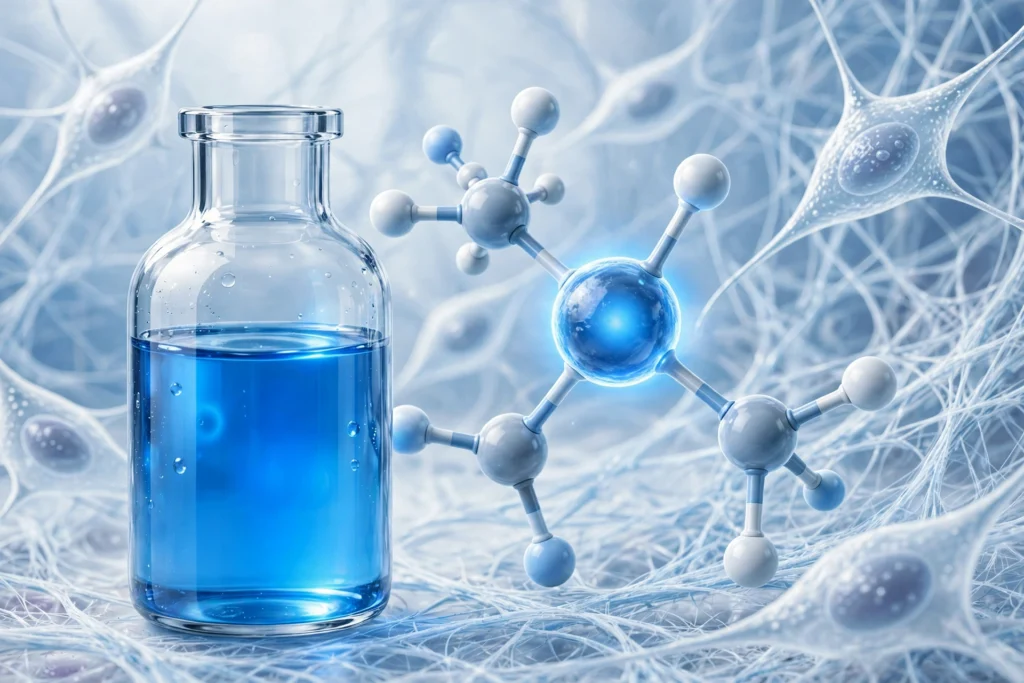
The blue color comes from the copper(II) ion complexed with the tripeptide. Free GHK without copper is colorless. The color is a convenient visual indicator of the copper complex but is not a substitute for analytical identity verification.
Generally, yes — most cosmetic “copper peptide” products use GHK-Cu (copper tripeptide-1). The research-grade material used in laboratory studies is a different supply chain with different purity documentation, and the two should not be conflated.
GHK-Cu peptide research offers something rare in the peptide space: a compound with a 50-year literature trail, a plausible multi-pathway mechanism, small but real human trials in skin and wound contexts, and an intriguing gene-expression footprint that keeps it relevant to aging biology. The honest assessment is also clear about limits: the human evidence is small, industry-funded, and confined to skin and wound applications, while the systemic and longevity claims circulating online remain preclinical speculation. For laboratory researchers, GHK-Cu is a well-characterized, multi-pathway tool for studying tissue repair, extracellular matrix biology, and copper-dependent biochemistry — valuable precisely where the evidence is strongest, and worth approaching skeptically everywhere else. Researchers building a broader reference library can browse our research peptide catalog for related compounds.
Related in the Apex shop: GHK-Cu research peptide — supplied strictly for laboratory research use.
This article is for laboratory research and educational purposes only. GHK-Cu is not approved by the FDA as a drug, and nothing here constitutes medical advice or instructions for human use. All peptides discussed are intended strictly for in vitro and laboratory research applications.
Selank peptide research starts with an unusual origin story. Most research peptides begin as fragments of a hormone or growth
Retatrutide Peptide Research: The Triple Agonist, TRIUMPH Trials and FDA Status Retatrutide peptide research is where incretin science stopped adding
Sermorelin Peptide Research: GHRH(1-29), GH Pulses and FDA History Sermorelin peptide research occupies an unusual place in the peptide literature:
Join the Apex list for research articles, compound guides, and subscriber-only offers. Enter your email and your 10% code appears instantly.
Use code Apex10
at checkout for 10% off.

Age Requirement
You must be 21 years or older to enter this website.
Apex Bio Industries is intended only for adults aged 21 and older. Individuals under the age of 21 are not permitted to access, purchase, or interact with products or content available through this website.
Research Use Only
All products offered by Apex Bio Industries are intended strictly for Research Use Only (RUO) purposes. These products are provided exclusively for laboratory research, scientific investigation, and educational purposes by qualified researchers and institutions. Products are not intended for human consumption, clinical use, medical treatment, diagnosis, prevention, or cure of any disease or condition. Apex Bio Industries does not provide medical advice, treatment recommendations, or instructions for personal use. Customers are responsible for ensuring that their purchase, handling, storage, and use of products comply with applicable laws, regulations, and institutional guidelines.
Please check the box above to confirm you are 21 years or older.