

Research Classes

Selank Peptide Research: Tuftsin Analog, GABA and BDNF Studies
Selank peptide research starts with an unusual origin story. Most research peptides begin as fragments of a hormone or growth
Looking for research-grade compounds?
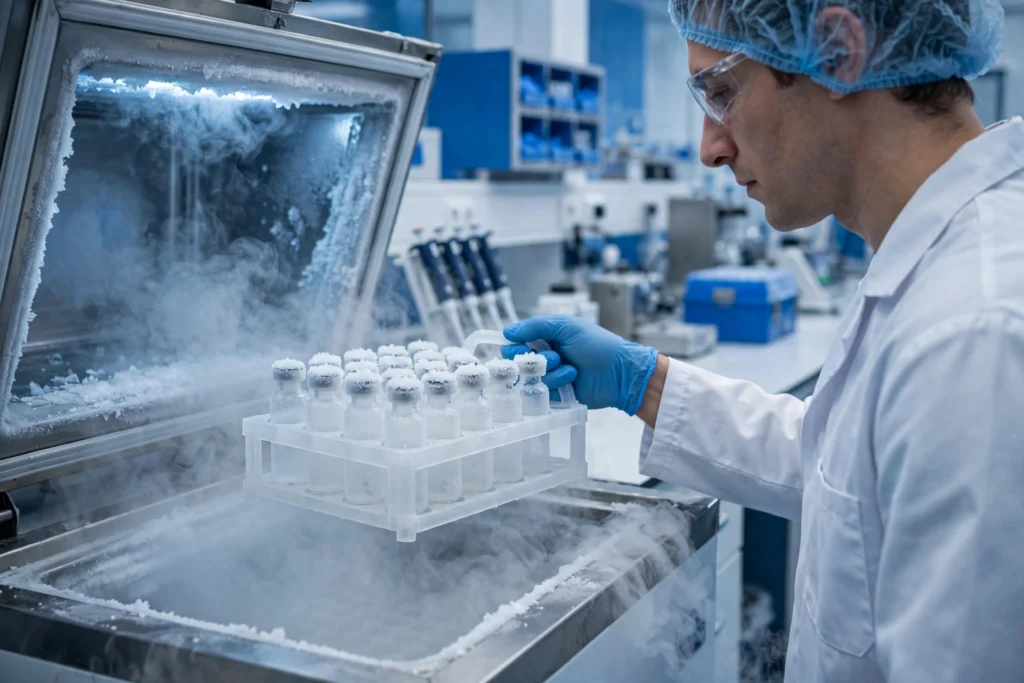
Peptide freeze thaw cycles sound harmless — freeze a solution, thaw it, use it — yet they are one of the most common and least visible ways researchers degrade their own material before an experiment even starts. A vial can look identical after five cycles while its contents have quietly aggregated, oxidized, or shifted in concentration, and the first sign of trouble is often an assay result that will not reproduce. This article explains what peptide freeze thaw cycles actually do at the molecular level, why lyophilized powder and reconstituted solution behave completely differently, which sequences are most vulnerable, and the aliquoting workflow laboratories use to make freeze-thaw damage a non-issue — all in a strict laboratory, research-use-only context.
Freezing slows chemical reactions, which is why frozen storage extends shelf life. But the act of freezing and thawing is itself a stress event, separate from the storage period in between. Work on protein and peptide formulation stability — including the freeze-thaw characterization literature published in Scientific Reports and the classic pharmaceutical studies of buffer behavior during freezing — identifies at least four distinct stresses that occur during every cycle. Understanding them explains why “it was frozen the whole time” is not the same as “it was protected the whole time.”
Ice crystals are nearly pure water. As a solution freezes, the growing ice excludes dissolved material, so the peptide, salts, buffer components, and dissolved oxygen are forced into ever-smaller channels of remaining liquid. This process, called cryoconcentration or freeze concentration, can raise the local concentration of solutes many-fold above the starting concentration.
For a peptide, that crowding matters. Molecules that were comfortably separated in dilute solution are pressed together at high local concentration and high ionic strength, which promotes the hydrophobic associations that seed aggregation. Aggregates formed in the freeze-concentrated fraction often do not fully redissolve on thawing — the vial returns to its nominal concentration, but a fraction of the peptide is now locked in particles or fibrils instead of being available as soluble monomer.
Every ice crystal presents a surface, and peptides and proteins adsorb to that ice-water interface. Adsorption at interfaces is a well-documented unfolding stress in the formulation literature: a molecule that partially unfolds at the ice surface exposes hydrophobic regions that are normally buried or, in a short peptide, normally transient. When those exposed regions meet similar regions on neighboring molecules — which cryoconcentration has conveniently pushed nearby — the result is aggregation that persists after thawing. The faster and more often a solution cycles, the more interfacial area it experiences over time.
The least intuitive stress is chemical. Buffer salts do not necessarily stay dissolved in proportion as water freezes. In sodium phosphate buffers, the disodium hydrogen phosphate component crystallizes out preferentially, and pharmaceutical studies of phosphate buffer systems have reported pH decreases as great as 3 pH units in the freeze concentrate — a nominally neutral solution can spend its frozen hours at a strongly acidic local pH. Potassium phosphate systems show different, generally smaller or opposite, shifts, which is one reason formulation scientists choose buffers with freezing behavior in mind.
For acid-sensitive sequences, hours spent at an unintended pH in a concentrated liquid channel accelerate real chemistry: aspartate-related cleavage and isomerization, deamidation, and hydrolysis all proceed faster away from a peptide’s stability optimum. The pH returns to normal on thawing, so a post-thaw pH check will not reveal that the excursion ever happened — only its chemical consequences remain.
Cryoconcentration concentrates dissolved oxygen along with everything else, and the freeze concentrate is where oxidation-prone residues — methionine and cysteine above all, with tryptophan also susceptible — sit in prolonged contact with it. Methionine oxidation to methionine sulfoxide adds a single oxygen atom (+16 Da on a mass spectrum) and can sharply change a peptide’s behavior in a research assay, because the oxidized side chain is bulkier and more polar than the original. This is chemical damage, not just physical aggregation, and no amount of careful thawing reverses it.
Most confusion about peptide freeze thaw cycles comes from mixing up two very different materials. A sealed vial of lyophilized (freeze-dried) powder and a vial of the same peptide in solution do not experience a freezer the same way at all.
| Material state | What freezing does | Freeze-thaw risk |
|---|---|---|
| Lyophilized powder, sealed and dry | Very little molecular mobility; no ice interface in bulk water, minimal hydrolysis without water | Low — main risks are moisture ingress and condensation when a cold vial is opened before equilibrating |
| Reconstituted solution, refrigerated (2–8 °C) | No freezing stress, but hydrolysis, deamidation and microbial risk proceed slowly | Moderate over time — a working solution has a limited refrigerated life |
| Reconstituted solution, frozen once, thawed once | One pass through cryoconcentration, interfacial and pH stresses | Acceptable for many sequences when aliquoted and handled correctly |
| Reconstituted solution, frozen and thawed repeatedly | The four stresses above, applied again every cycle, with damage that compounds | High — the pattern this article is about |
This is why the standard guidance in our overview of peptide storage best practices for research labs treats the dry powder and the working solution as two different storage problems. The powder is the stable archive form. The solution is a perishable working reagent — and every freeze-thaw cycle spends some of its integrity.
Freeze-thaw sensitivity is sequence-dependent. Researchers reviewing a new compound should scan its sequence for the features that formulation studies associate with the highest risk:
| Sequence feature | Freeze-thaw vulnerability |
|---|---|
| Methionine or free cysteine | Oxidation in the oxygen-rich freeze concentrate; cysteine can also drive disulfide scrambling |
| Asparagine followed by glycine or serine | Deamidation-prone motif; accelerated by pH excursions during freezing |
| Aspartate residues | Acid-catalyzed cleavage and isomerization during phosphate-buffer pH drops |
| Long hydrophobic stretches | Aggregation and fibril formation under cryoconcentration; amylin-like amyloid-prone sequences are the extreme case |
| Disulfide bonds | Interfacial unfolding can expose bonds to exchange reactions that scramble the pairing |
| High working concentration | More molecules per freeze-concentrated channel means faster aggregation kinetics |
Short, hydrophilic peptides with none of these features can be comparatively forgiving — published formulation case work includes peptide solutions that showed no aggregation after five controlled cycles — while other formulations in the same literature precipitated after three cycles with measurable aggregate growth by size-exclusion chromatography. That spread is exactly the point: there is no universal “safe number of cycles” that applies across compounds, buffers, and concentrations, and any source quoting a single fixed percentage loss per cycle for all peptides is oversimplifying. The defensible laboratory default is to design the workflow so the question never has to be answered for a vial you care about: freeze once, thaw once, per aliquot.
Freeze-thaw damage is usually invisible to the eye until it is advanced — visible cloudiness or particles mean extensive aggregation — but it is readily visible to the analytical methods researchers already use to verify research peptides:
This is also why comparing a working aliquot against the batch Certificate of Analysis only works if the material was handled so the COA still describes it. Our walkthrough of how to read a Certificate of Analysis (COA) covers which reported values — purity, identity, net content — freeze-thaw stress can move after the fact. Researchers sourcing material for a new study can browse the current research peptides at Apex Bio catalog and match each compound’s COA to its sequence vulnerabilities before planning storage.
Laboratories that run peptides routinely converge on the same workflow, because it removes freeze-thaw cycling from the system rather than trying to tolerate it:
Two buffer choices support the same goal: where an assay permits it, prefer buffer systems with modest freezing pH shifts over sodium phosphate for solutions that will be frozen, and keep buffer concentration no higher than the experiment requires, since the pH excursion scales with the amount of crystallizable buffer salt.
There is no compound-independent number. Published formulation work ranges from peptide solutions stable through five controlled cycles to formulations precipitating after three, depending on sequence, buffer, concentration, and freeze/thaw rates. The research-grade practice is to aliquot for single use and treat repeated cycling of a master vial as a known integrity risk, not a storage method.
Each refreeze applies the full set of stresses again — cryoconcentration, interfacial exposure, and any buffer pH excursion — regardless of how briefly the aliquot was thawed. Time at room temperature adds its own hydrolysis and oxidation exposure on top. Single-use aliquot sizing exists precisely to avoid this decision.
No. The stresses described here require bulk water: ice interfaces, freeze-concentrated liquid channels, and buffer crystallization are solution phenomena. Sealed, dry lyophilized powder is comparatively stable frozen for extended periods; its main enemies are moisture and condensation when cold vials are opened before equilibrating.
Not necessarily. Oxidation, deamidation, and early soluble aggregation are all invisible. Clarity rules out advanced aggregation only. Where a result matters, HPLC comparison against the original COA profile is the check that actually answers the question.
Progressive freeze-thaw damage to a repeatedly cycled master vial is one of the most common explanations, alongside refrigerated age of a working solution and moisture exposure of the powder. The pattern — same vial, same protocol, declining performance — should prompt an analytical check of the vial and a switch to single-use aliquots for the replacement material.
Related in the Apex shop: research peptides at Apex Bio — supplied strictly for laboratory research use.
Research Use Only disclaimer: All products and information discussed here are intended strictly for laboratory research use only (RUO) by qualified researchers. Nothing in this article is medical advice, a dosing recommendation, or an efficacy claim, and research peptides supplied by Apex Bio Industries are not intended for human or animal consumption, clinical use, diagnosis, or treatment of any condition.
Selank peptide research starts with an unusual origin story. Most research peptides begin as fragments of a hormone or growth
Retatrutide Peptide Research: The Triple Agonist, TRIUMPH Trials and FDA Status Retatrutide peptide research is where incretin science stopped adding
Sermorelin Peptide Research: GHRH(1-29), GH Pulses and FDA History Sermorelin peptide research occupies an unusual place in the peptide literature:
Join the Apex list for research articles, compound guides, and subscriber-only offers. Enter your email and your 10% code appears instantly.
Use code Apex10
at checkout for 10% off.

Age Requirement
You must be 21 years or older to enter this website.
Apex Bio Industries is intended only for adults aged 21 and older. Individuals under the age of 21 are not permitted to access, purchase, or interact with products or content available through this website.
Research Use Only
All products offered by Apex Bio Industries are intended strictly for Research Use Only (RUO) purposes. These products are provided exclusively for laboratory research, scientific investigation, and educational purposes by qualified researchers and institutions. Products are not intended for human consumption, clinical use, medical treatment, diagnosis, prevention, or cure of any disease or condition. Apex Bio Industries does not provide medical advice, treatment recommendations, or instructions for personal use. Customers are responsible for ensuring that their purchase, handling, storage, and use of products comply with applicable laws, regulations, and institutional guidelines.
Please check the box above to confirm you are 21 years or older.